

How can artificial intelligence remain trustworthy when it is no longer trained or managed by a single central authority? As AI increasingly moves across cloud platforms, edge devices and connected IoT infrastructures, answering this question has become fundamental to the future of distributed computing.
This challenge was at the centre of CoGNETs’ participation in the International Conference on Engineering, Technology and Innovation (IEEE ICE 2026), held in Porto, Portugal, from 22 to 25 June 2026. Bringing together researchers, engineers, innovators and policymakers, the conference explored how collaborative innovation can drive competitiveness, sustainability and resilience through emerging digital technologies.
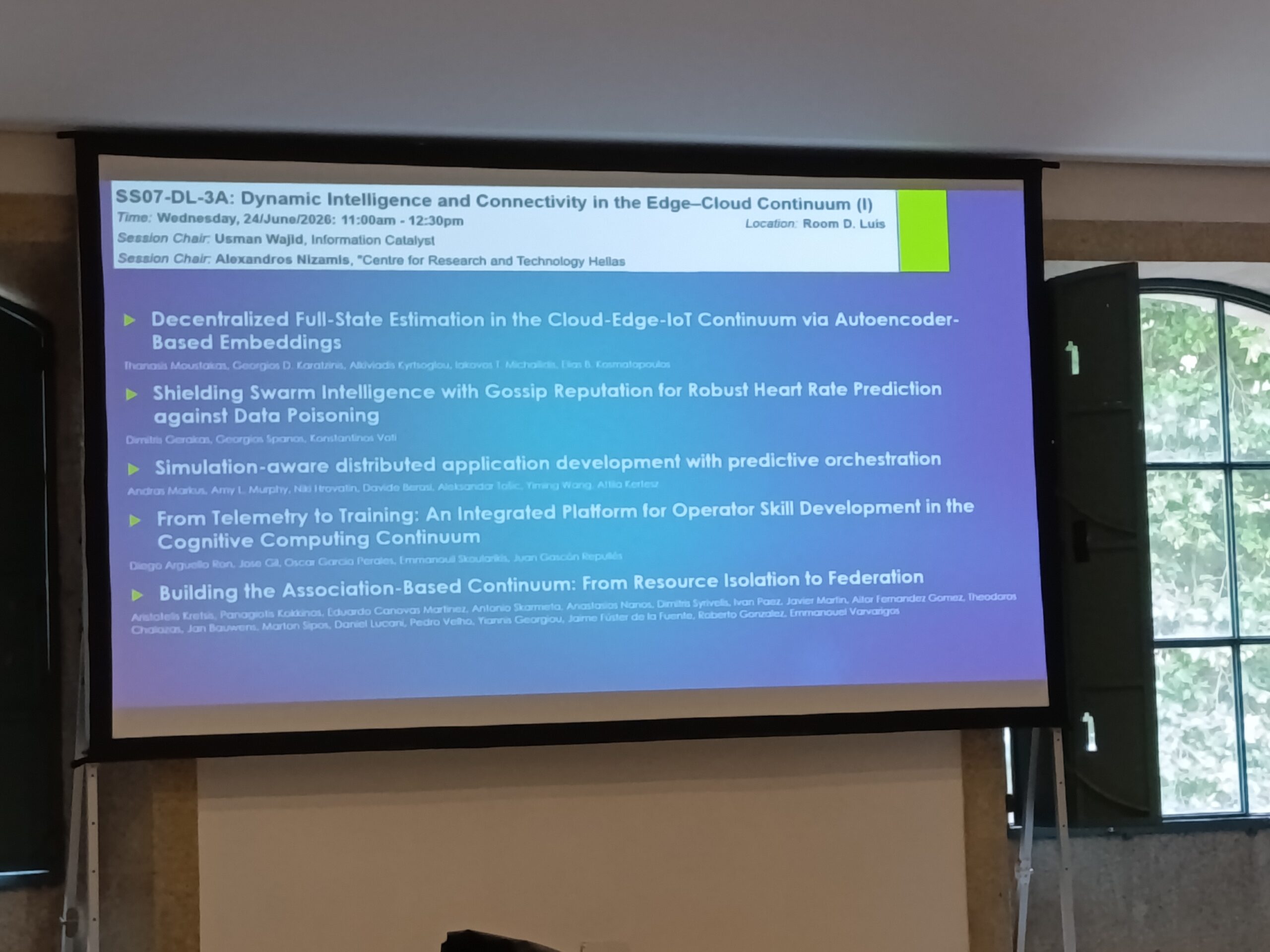
On 24 June, Dimitris Gerakas (Centre for Research and Technology Hellas – CERTH) represented CoGNETs in the special session “Dynamic Intelligence and Connectivity in the Edge–Cloud Continuum (I)“. The session, chaired by Usman Wajid (Information Catalyst) and Alexandros Nizamis (CERTH), was organised as an initiative of the Horizon Europe project ENACT, bringing together sister projects working on the Cognitive Computing Continuum to exchange advances in distributed intelligence, AI orchestration and next-generation computing infrastructures.
Building trust in decentralised AI
Gerakas presented its latest research, “Shielding Swarm Intelligence with Gossip Reputation for Robust Heart Rate Prediction against Data Poisoning,” co-authored with Georgios Spanos and Konstantinos Votis, addressing one of the fundamental challenges facing fully decentralised federated learning.
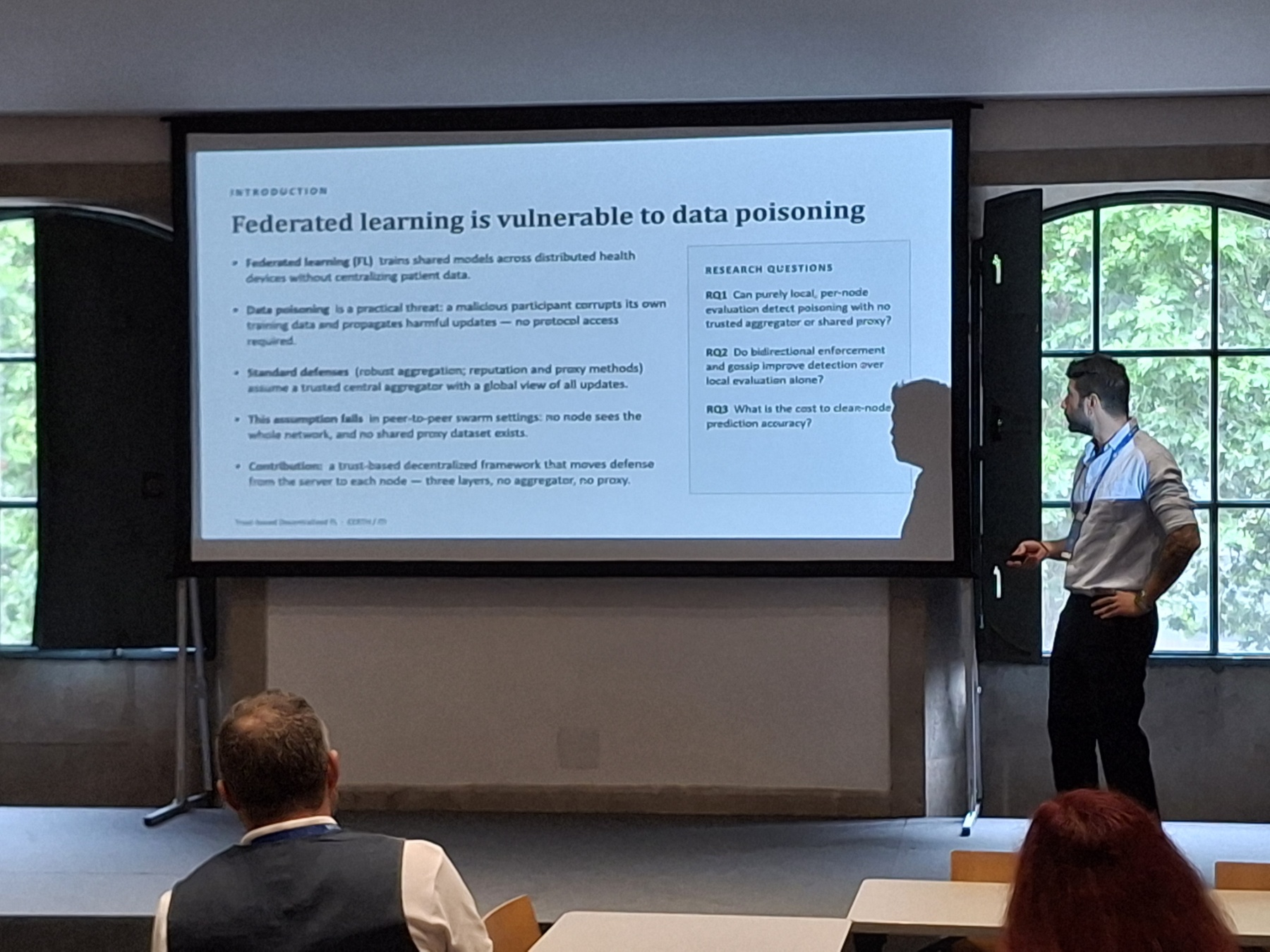
Federated learning enables connected devices, such as wearable health sensors, to collaboratively train AI models without exchanging raw personal data, making it particularly attractive for privacy-sensitive applications like digital health. However, removing the central server also removes a trusted authority capable of identifying malicious participants. Existing defence mechanisms typically rely on such a global view, leaving fully peer-to-peer federated learning vulnerable to data poisoning attacks.
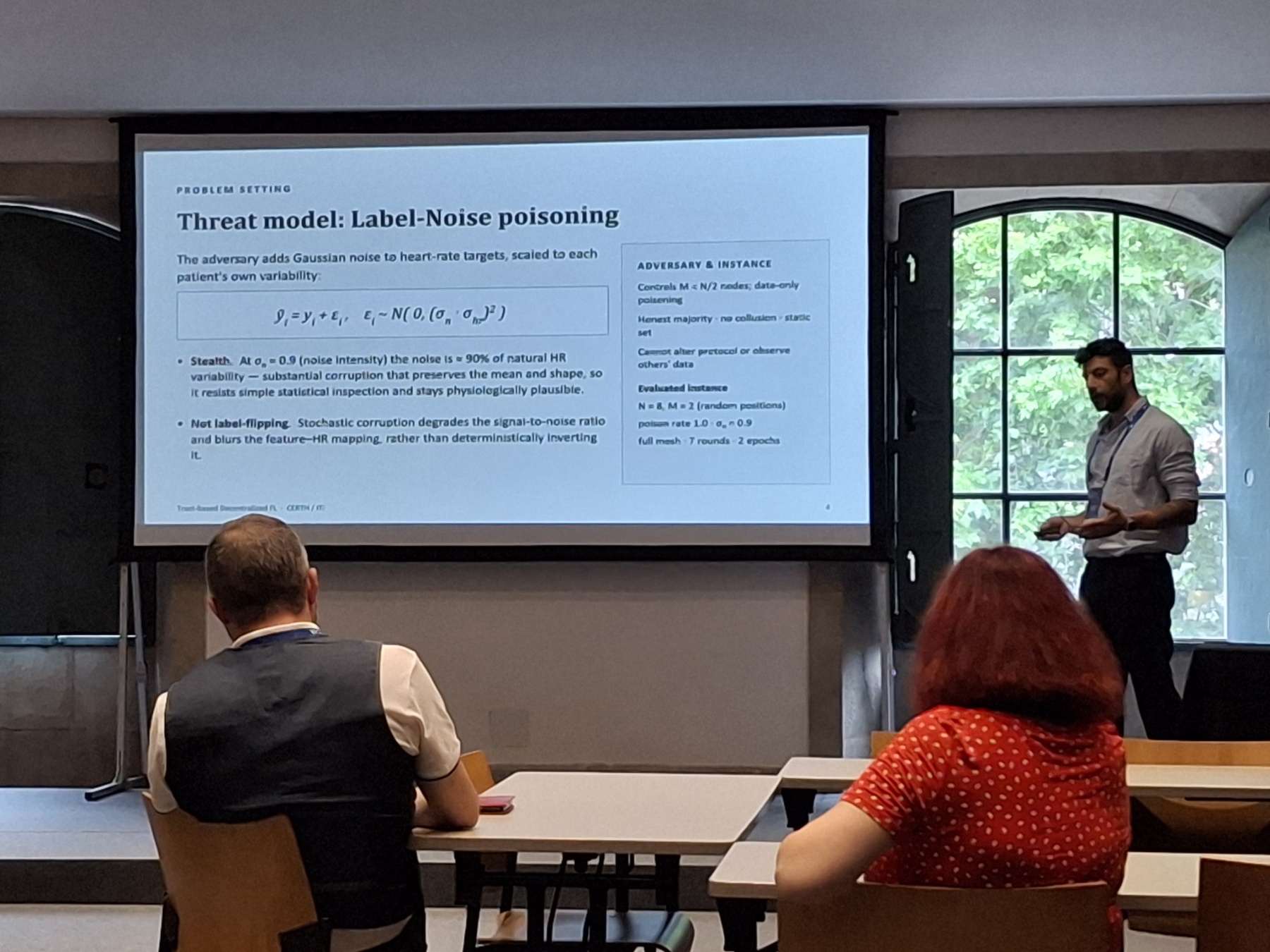
To address this gap, the CoGNETs framework draws inspiration from swarm intelligence, allowing trust to emerge collectively across the network rather than being imposed centrally. Each participating device independently evaluates the quality of its neighbours’ model updates, continuously builds local trust scores, and selectively exchanges reputation information with trusted peers through a gossip-based mechanism. Together, these local interactions enable the network to identify unreliable participants without requiring central coordination.
Evaluated using real wearable heart-rate data from 22 participants, the approach increased the detection of malicious devices from roughly one third to more than 90%. Perhaps even more remarkably, the protected network achieved higher prediction accuracy than an undefended system operating without attacks, demonstrating that decentralised trust mechanisms can simultaneously improve both the resilience and the quality of collaborative AI.
Advancing intelligence across the computing continuum
The session showcased complementary research tackling different dimensions of the Cognitive Computing Continuum. From communication-efficient state estimation using AI-generated embeddings to predictive orchestration of distributed edge applications, the presentations explored how intelligence can be deployed more efficiently across increasingly heterogeneous computing environments.
Other contributions demonstrated integrated platforms for training operators to manage complex continuum infrastructures through real-time telemetry and virtual learning environments, while new architectural approaches for federating heterogeneous cloud, edge and IoT resources illustrated how autonomous resource sharing can support scalable and trustworthy distributed applications.
Although approaching the challenge from different perspectives, all presentations addressed a common objective: enabling infrastructures that can adapt, coordinate and optimise themselves across highly distributed environments, reducing complexity while improving resilience and efficiency.
Strengthening Europe’s collaborative research ecosystem

The special session also highlighted the growing collaboration between Horizon Europe projects working on the Cognitive Computing Continuum. By bringing together initiatives including CoGNETs, ENACT and EMPYREAN, the session provided a platform to exchange ideas, identify technical synergies and discuss how complementary research efforts are collectively advancing Europe’s capabilities in distributed AI and intelligent computing infrastructures.
For CoGNETs, participation in IEEE ICE 2026 represented another opportunity to disseminate research that bridges fundamental AI innovation with practical deployment challenges. As distributed intelligence becomes increasingly central to applications ranging from healthcare and manufacturing to mobility and smart infrastructures, developing mechanisms that enable AI systems to collaborate securely, efficiently and autonomously will be essential to unlocking the full potential of the Cognitive Computing Continuum.