

The CoGNETs Health Pilot Use Case explores how collaborative learning, adaptive computing and secure data processing could help healthcare organisations make better use of their increasingly connected digital infrastructure.
Healthcare systems generate enormous quantities of data, yet much of this information remains difficult to use across different devices, institutions and digital platforms. Wearable sensors continuously record physiological measurements, medical equipment produces detailed observations, and hospital information systems manage complex clinical and operational processes. Turning these separate streams into useful intelligence remains a considerable challenge.
Artificial intelligence offers new possibilities for interpreting medical data and supporting healthcare professionals. But deploying AI across connected healthcare environments introduces technical and organisational difficulties. Sensitive patient information cannot always be transferred between institutions, computing resources vary considerably, and digital services must remain reliable even when networks or individual components encounter problems.
Through its Health Pilot Use Case (PUC3) on Connected Healthcare, the Horizon Europe CoGNETs project is investigating how distributed intelligence across the Internet of Things (IoT), Edge and Cloud computing continuum could help address these challenges.
Rather than concentrating data processing and AI in a single location, CoGNETs is developing an infrastructure in which devices, computing resources and AI services can collaborate across different environments.
Bringing intelligence closer to healthcare data
One of the central technologies being investigated is collaborative federated learning. Unlike conventional machine-learning approaches that often require data to be collected in a central repository, federated learning allows AI models to be trained across different locations while the underlying datasets remain local.
This is particularly relevant to healthcare, where institutions must protect sensitive medical information and comply with stringent data governance requirements.
The approach forms part of a broader CoGNETs architecture that connects medical IoT devices, edge computing resources and cloud infrastructure. Some data processing and AI tasks can take place close to the source, while others may benefit from additional computational resources elsewhere in the network.
The project’s adaptive middleware is intended to coordinate these distributed resources, allowing AI services to operate across environments with different computing capabilities, connectivity conditions and operational requirements.
For healthcare organisations, such an approach could reduce dependence on centralised infrastructure while supporting more flexible deployment of AI-enabled services.
From medical forecasting to network security
The Health PUC investigates two complementary areas of data analysis.
The first concerns forecasting from time-series data, including physiological measurements collected by connected medical devices. By analysing how these signals change over time, machine-learning models can identify patterns and generate predictions that may support monitoring and healthcare decision-making.
The second concerns network-flow analysis. As healthcare services become more connected, their reliability increasingly depends on communication between devices, hospital networks, computing infrastructure and remote services. Analysing network activity can help identify abnormal behaviour and potential cybersecurity threats.
Both areas highlight why healthcare AI requires more than capable algorithms. Data must be processed securely, computing resources must be available when needed, and the infrastructure connecting different systems must remain dependable.
The Health PUC therefore combines medical data analytics with research into collaborative learning, distributed computing and cybersecurity.
A collaborative effort across European research and industry
The Health PUC draws on expertise from several CoGNETs partners.
CERTH (Centre for Research and Technology Hellas) contributes expertise in artificial intelligence and distributed learning, working closely with HMU (Hellenic Mediterranean University) on the healthcare scenario. HMU provides expertise in network security in this pilot use case.
MEDITECH Competence Center brings expertise in distributed middleware, interoperability and data management, supporting the integration of heterogeneous devices and services. VTT Technical Research Centre of Finland contributes to the project’s collaborative federated learning framework and AI technologies for distributed computing environments.
Together, these partners are exploring how the different components of the CoGNETs architecture can support healthcare applications while addressing the technical constraints of real-world deployment.
Putting distributed learning to the test
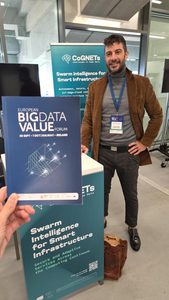
A recent demonstration at the European Big Data Value Forum (EBDVF) 2026in Galway offered a practical illustration of the project’s research.
Presented by Dimitris Gerakas from CERTH, 4 Ways to Trust a Heartbeat compared four machine-learning approaches across three simulated healthcare institutions. Using heart-rate and movement data, the experiment examined how different learning architectures handle collaboration and what happens when one participant contributes unreliable information.
The demonstration illustrated both the opportunities and challenges of distributed learning. Keeping medical data local can reduce the need to exchange sensitive datasets, but it also raises questions about how participating institutions establish trust and protect shared models from unreliable contributions.
Towards more adaptable healthcare infrastructure
The potential applications of this research extend across the healthcare technology ecosystem.
Healthcare providers could benefit from AI services that make use of distributed information without requiring extensive centralisation. Medical device manufacturers could integrate connected products into wider intelligent systems, while software developers could build monitoring, forecasting and analytical services on top of more adaptable infrastructure.
Systems integrators and infrastructure providers may also benefit from technologies that connect existing healthcare IT environments with distributed AI services.
These opportunities remain dependent on successful technical validation, interoperability, regulatory compliance and practical adoption. CoGNETs is investigating the underlying technologies and requirements rather than delivering a finished clinical product.
As healthcare becomes increasingly dependent on connected devices and AI-supported services, the infrastructure through which information is processed, exchanged and protected will become just as important as the algorithms themselves.
By combining collaborative learning, adaptive computing and secure data processing, CoGNETs is exploring how healthcare organisations could make better use of distributed intelligence while retaining control over sensitive information.