

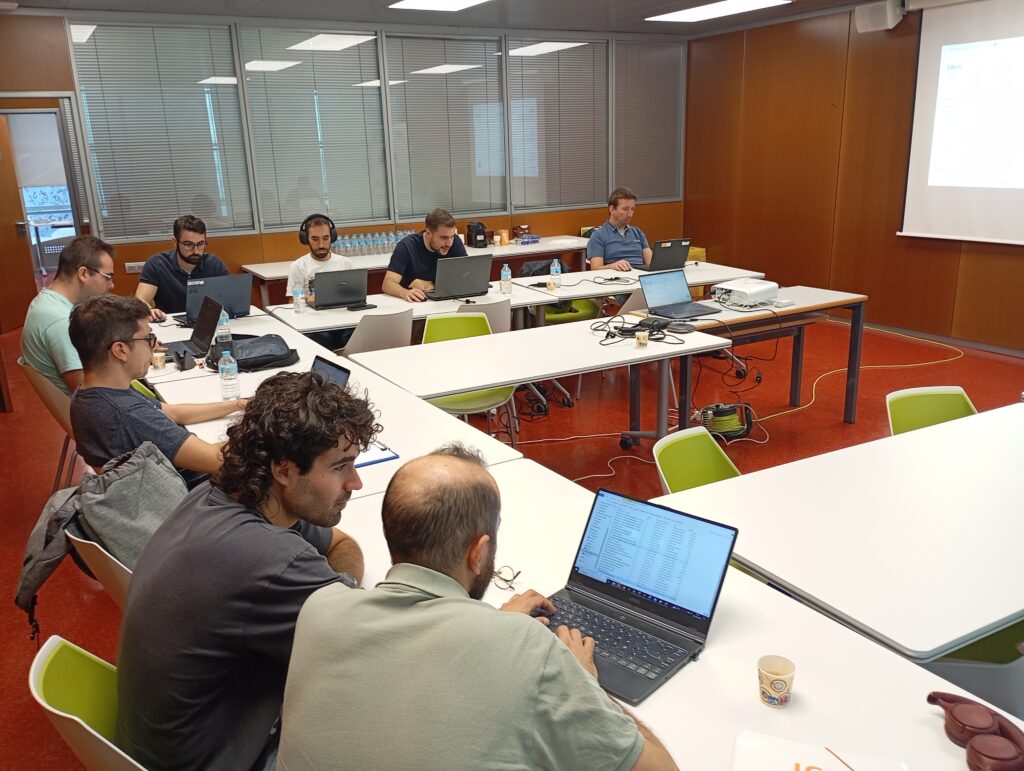
Ten teams took on the CoGNETs challenge at VelesHack 2026 in Valencia, developing intelligent agents to compete for shared computing resources in decentralised edge networks.
From 6 to 8 October 2026, developers, students and researchers gathered at the Universitat Politècnica de València (UPV), Spain, for VelesHack 2026, a hybrid hackathon dedicated to emerging technologies across the Edge-to-Cloud computing continuum.
Among the event’s four technical challenges was “Smart Edge Resource Auctions,” developed around research from the Horizon Europe CoGNETs project. The challenge invited participants to explore how intelligent devices can independently negotiate access to limited computing resources, putting game-theoretic approaches to distributed computing into practice.
Representing CoGNETs, Christos Zavitsanos, Research Assistant at the Centre for Research and Technology Hellas (CERTH), mentored participating teams throughout the competition on 6 and 7 October and contributed to the evaluation of their submissions.
When intelligent devices compete for resources
As computing becomes increasingly distributed across connected devices, edge infrastructure and cloud platforms, deciding how to allocate limited resources is a growing technical challenge.
Conventional approaches often rely on centralised systems to determine which devices receive computing capacity. CoGNETs investigates an alternative: enabling devices to make autonomous decisions and negotiate resource allocation through game-theoretic mechanisms.
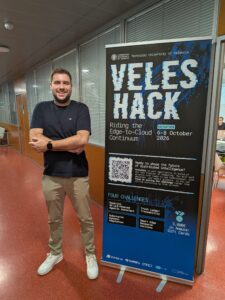
The VelesHack challenge translated this research into a practical programming exercise.
Each team was tasked with developing an intelligent software agent capable of joining a swarm of edge devices and competing for three shared resource pools: computing capacity, energy and security.
Resources were allocated through a game-theoretic auction in which each device received a share proportional to its bid. Increasing one device’s allocation therefore reduced the resources available to others.
Participants had to design agents capable of making strategic decisions in this competitive environment, balancing their own resource requirements against the behaviour of neighbouring devices and the constraints of the wider network.
Ten teams explore the value of strategic restraint
The challenge attracted 10 team submissions through the TAIKAI hackathon platform, giving participants two competition days to develop and test their approaches.
One of the most interesting observations was that effective resource management did not necessarily mean bidding more aggressively.
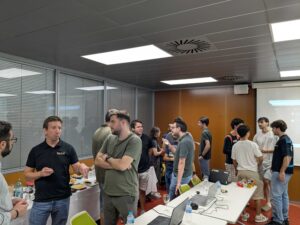
Instead, the strongest approaches demonstrated the importance of strategic restraint. Successful agents considered how frequently they could afford to participate in auctions, observed the behaviour of other devices before committing resources, and adapted their strategies to the wider swarm.
These findings reflect a central research question within CoGNETs: how can autonomous devices pursue their own objectives while contributing to the efficient operation of a shared computing environment?
By working directly with a simplified resource-allocation problem, participants gained practical experience with the challenges of decentralised decision-making, competition and coordination.
Bringing European research into developers’ hands
VelesHack 2026 offered an opportunity to introduce CoGNETs research to a wider community of developers and emerging technology specialists.
Rather than presenting game-theoretic resource allocation solely as a research concept, the challenge allowed participants to experiment with the underlying mechanisms, develop their own decision-making strategies and evaluate how autonomous agents behave in a competitive environment.
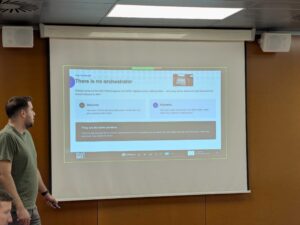
The hackathon featured four challenges covering AI-powered developer assistants, decentralised edge resource allocation, Kubernetes-based application deployment and distributed ledger trust dashboards.
The event was supported by four Horizon Europe projects: CoGNETs, ENACT, HYPER-AI and O-CEI, reflecting their shared interest in advancing distributed computing, intelligent infrastructure and trustworthy digital technologies.
For CoGNETs, participation also contributed to the project’s wider dissemination and community engagement activities, connecting its research on swarm intelligence and autonomous resource management with developers who can experiment with these technologies firsthand.
The experience in Valencia demonstrated that intelligent resource allocation is not simply about securing the largest possible share of computing capacity. It is about understanding when to compete, when to conserve resources and how individual decisions affect the wider network.