

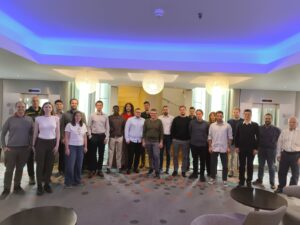
In the CoGNETs 5th Plenary Meeting in Bucharest, the CoGNETs partners took stock of a working proof of concept and prepared to bring self-organising device swarms into a hospital, a vehicle fleet and a factory.
When machines share the work
What if the machines around us could share the work among themselves? A hospital device, an electric car or a factory robot would decide together who handles which task, and where, without waiting for instructions from a distant data centre.
That is the idea behind CoGNETs, a Horizon Europe project inspired by the way swarms of bees or birds organise themselves. Each device gets a small software agent that negotiates for tasks, a bit like bidding in an auction. Together, the devices balance speed, energy use and security on their own, and keep sensitive data close to where it is produced.
On 21–22 October 2026, the project partners met in Bucharest for their 5th plenary meeting, hosted by Siemens, with colleagues joining online. The big news: the CoGNETs software now runs end to end as a proof of concept on the project’s testbed, and a six-month extension gives the project more time to take it into the pilots.
A swarm without a single point of failure
In earlier designs, one device coordinated the swarm, and if it failed, everything stopped. The project has now moved to a design in which any capable device can take on that role, chosen by the swarm itself. First tests are encouraging: when the coordinating device is switched off, another takes over almost immediately and the work carries on. New devices can join the swarm on their own, without anyone having to configure them.
The new design also opens the door to everyday hardware. Phones, smartwatches and home appliances that are too small to run the full software can join through a nearby device that represents them, and large AI models are stored separately so that a device dropping out never takes the shared model with it.
From the lab to real settings
Most of the meeting went to the three pilots, where CoGNETs will be tested in real conditions. Each has moved from plans to working building blocks, and each is now at a different stage on the way to its final demonstration:
- Manufacturing: working robot cell, preparing the final demonstration. Robots recognise parts in real time and have completed their first pick-and-place tasks, and learning across companies without sharing their data has been tested. The team is now adding a second robot, moving the AI onto small edge devices and connecting the cell to the swarm.
- Mobility: AI models trained, moving to a swarm. The AI that learns smarter cabin climate control for electric vehicles is trained and running in a cloud test environment. The next step is to turn it into a decentralised service, with several virtual vehicles sharing what they learn.
- Health: scenarios defined, integration under way. The ways in which heart-rate monitoring devices learn together, either among themselves or with a hospital cloud, are designed, as are the attacks the system must withstand. The team is now connecting the devices into one swarm with secure sign-on for each device.
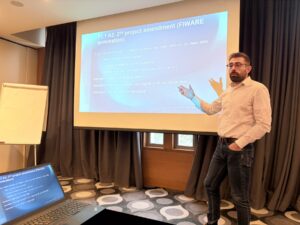
The final demonstrations are taking shape, from moving AI services between devices on the fly to responding safely to a cyberattack. Partners also agreed on a joint demonstration that links devices from all three pilots in one swarm.
Built for trust and impact
Technology alone is not enough. The project has mapped the results that could live on beyond its lifetime, from software components to AI models, and will focus on the most promising ones. A market analysis and a first roadmap for contributing to standards are in place, and CoGNETs has joined the Horizon Standardisation Booster, an EU service that helps research projects feed into European standards.
Responsible innovation is built in too. Partners will use a shared toolkit throughout the pilots to track consent, data protection, gender balance and environmental impact, and to check their AI against the EU’s guidelines for trustworthy AI.
What comes next
Thanks to the six-month extension, CoGNETs now runs until November 2027, giving the pilots the time they need to reach their final demonstrations. In the coming months, the CoGNETs software will be installed at the pilot sites, and a test across sites will check that devices far apart can still negotiate fast enough to act as one swarm. The teams will then finalise their demonstrations and the measures of success they will be judged against. Visitors can see the manufacturing pilot up close at the Fraunhofer IPK stand at the “all about automation” trade fair in Berlin on 27–28 January 2027.
The consortium thanks Siemens for hosting the meeting in Bucharest, and all partners who joined in person and online.