

In brief
The issue: devices can train an ML model together without sharing their data, but one compromised device can secretly plant a hidden “backdoor” in the shared model.
The finding: existing defences only work if the right part of the system runs them, from the start. Most cannot remove a backdoor that is already in place.
Why it matters: hospitals, vehicles and factories that want to train AI together need to know where to put their safeguards. CoGNETs uses these insights to secure its device swarms.
A conference on the networks of tomorrow
For more than two decades, the International Conference on Wireless and Mobile Computing, Networking and Communications (WiMob) has brought together researchers and engineers working on wireless and mobile technology. Its 22nd edition, held at the Avignon Grand Hotel in France, focused on 5G, the Internet of Things, cybersecurity and artificial intelligence for mobile and wireless networks.
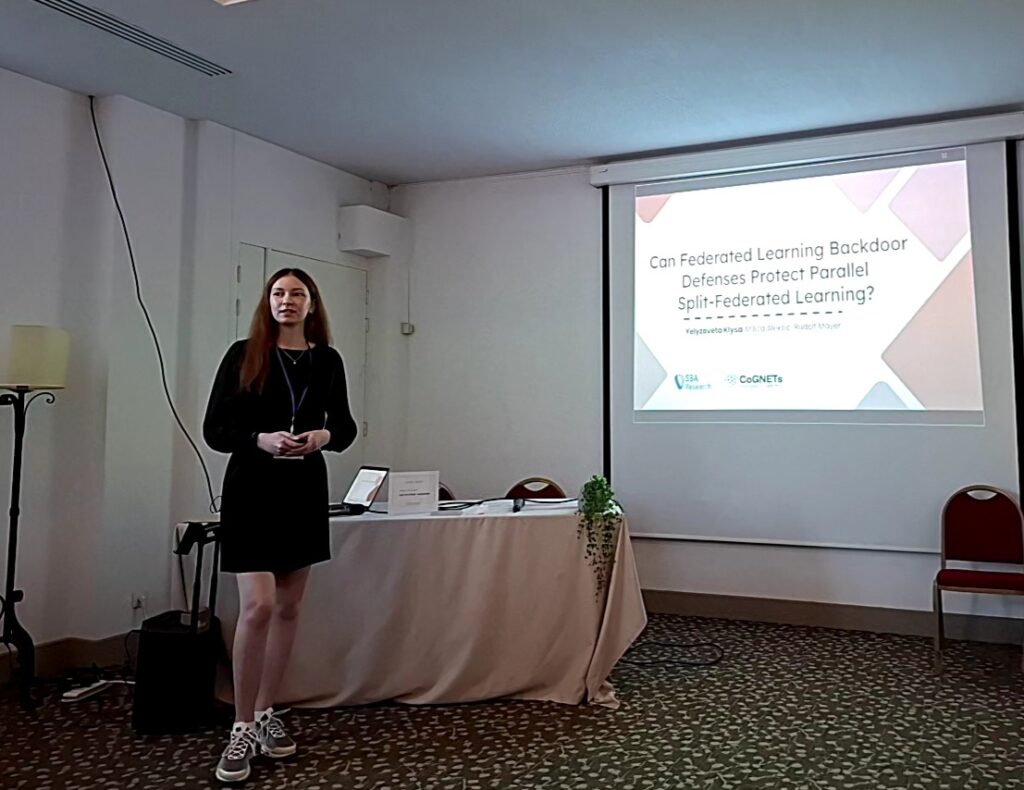
On 16 October 2026, in a session on the security and robustness of federated learning, Yelyzaveta Klysa from SBA Research presented the paper “Can Federated Learning Backdoor Defenses Protect Parallel Split-Federated Learning?”. She wrote it with her colleagues Milica Aleksic and Rudolf Mayer, with funding in part from CoGNETs. The paper is now published in the conference proceedings.
Learning together without sharing data
Many of the most useful AI models are trained on data that cannot leave the place where it is collected: patient records in a hospital, sensor readings on a production line, driving data in a car. Federated learning addresses this. Instead of sending raw data to a central server, each participant trains a copy of the model locally and shares only the model updates, which are then combined into a single, improved model.
There is a catch. Training a modern neural network is demanding, and devices at the edge of a network, such as sensors, wearables or in-vehicle units, often lack the memory and computing power to do it. Split learning addresses this by cutting the model in two. The device runs the first few layers and sends an intermediate, already-transformed version of its data to a more powerful server, which completes the training.
Split-federated learning combines both ideas: many devices train in parallel, each handling only a light front section of the model, while a server carries the heavy part. It is increasingly used in distributed edge applications as a way to make collaborative AI more trustworthy, because raw data stays local and small devices can still take part.
A hidden trigger in a shared model
Collaboration brings a new risk. A participant that has been compromised can try to plant a backdoor in the shared model, for example by training on deliberately poisoned data. A backdoored model behaves normally almost all of the time, which makes it hard to spot, but reacts in a way chosen by the attacker whenever a specific trigger appears in the input. In the study’s traffic-sign experiments, a small pattern added to an image could make a sign classifier read any sign as “Priority Road”.
Earlier research had already shown that split-federated learning is vulnerable to such attacks. Many defences exist for classic federated learning, but nobody had checked systematically whether they still protect a split-federated system. Such a system has not one but two points where contributions are combined: a server that merges the devices’ small model sections, and a main server that trains the larger part of the model.
Who guards the model, and when?
Those two servers may not be run by the same organisation, and that changes who is in a position to defend the system. Think of two checkpoints on the same road: a threat that slips through the first can still be stopped at the second, but only if someone there is actually checking. The SBA Research team therefore defined several realistic threat models, based on who is trusted and on when a defence is switched on:
- The main server defends itself. The operator of the main server filters out suspicious contributions to protect its part of the model.
- The devices ask for protection. Honest participants want to protect their part of the model from malicious peers and ask for defences at the server that merges the device-side sections.
- Both servers cooperate. Defences run on both sides, either from the very start of training or only later, once a backdoor may already be partly in place. The later case reflects real situations, such as a defence that becomes available while training is already under way.
In every scenario, the defender knows neither which participants are malicious nor what the trigger looks like, and never sees anyone’s raw data, just as in a real deployment.
The researchers set up a parallel split-federated system with twenty participating devices, four of them controlled by an attacker. They tested four well-known backdoor attacks against five established defences (for specialists: the BadNets, DBA, Neurotoxin and model-replacement attacks against Multi-Krum, MMetric, AlignIns, FoolsGold and FedDLAD) on three image-recognition tasks of increasing difficulty: handwritten digits, everyday objects, and a benchmark of real German traffic signs.
What they found
- Who deploys the defence matters most. Defences run only where the devices’ model sections are merged did not stop the attacks. The backdoor travels through the intermediate data that devices send onwards and ends up in the main server’s part of the model. Defences run at the main server did stop it: the attack’s success rate fell to roughly 5% on the everyday-objects task and to below 1% on traffic signs. The main server is therefore the critical point of defence.
- Defences do not simply transfer. Methods designed for classic federated learning assume a single point where contributions are combined, and that assumption no longer holds. Two of the five defences failed in most or all scenarios. Only one, a recent method called AlignIns, was effective across most threat models.
- Timing matters, and so does the task. Switched on from the first round, defences at the main server prevented the backdoor from being learned. Switched on later, once the backdoor had taken hold, most of them failed.
The delayed scenario produced the study’s most surprising result: how well a late defence works depends strongly on how complex the task is. On the traffic-sign task, AlignIns cut the attack’s success from almost 100% to 0.2% even after the backdoor had fully taken hold, and on everyday objects from 96% to 11%. On the simplest task, handwritten digits, the backdoor took hold within a few dozen rounds and no defence could remove it afterwards. A simple task is not automatically a safe one.
According to the authors, this is the first structured comparison of backdoor defences for parallel split-federated learning. Their code is openly available, so that other researchers can reproduce and extend the experiments.
Conference group photo in Avignon. Photo: WiMob 2026
How it fits into CoGNETs
CoGNETs is building middleware for the computing continuum, the chain of resources that runs from small IoT devices through edge nodes to the cloud. In a CoGNETs “swarm”, devices cooperate on tasks, including training AI models, without sending everything to one central data centre. Two strands of the project’s work meet in this paper.
- Collaborative learning on constrained devices. CoGNETs is developing a collaborative federated learning framework in which models can be pruned or split, so that devices with limited resources can still take part in training. Split-federated learning is one way to achieve this, and it is the setting the paper examines.
- End-to-end security. SBA Research leads the project’s work on security, identity, privacy and resilience. This includes protecting the AI components of the swarm against adversarial manipulation, such as poisoned contributions to a shared model.
The threat models in the paper are especially relevant to CoGNETs. In a decentralised swarm, nodes may belong to different organisations, and the roles of aggregator and participant can shift from one device to another. Knowing which role must carry the defence, and that it should run from the start, helps decide how security is built into the swarm.
The findings also support the project’s pilots, where federated learning security is part of the scenarios being tested, and they add to CoGNETs’ portfolio of open scientific publications.
Why it matters beyond the lab
Split-federated learning is attractive wherever data is sensitive and devices are small. Those are exactly the conditions in the sectors where CoGNETs is piloting its technology.
- Health. Hospitals and care settings could jointly train diagnostic models on data that never leaves their premises. A backdoor in such a model could cause targeted misdiagnoses that are hard to detect, so robust defences are a precondition for trust.
- Mobility. Vehicles and roadside units could improve perception models together, using the computing power of the edge. The study’s traffic-sign experiments show what is at stake: a model that misreads a sign whenever a hidden trigger is present is a safety risk.
- Manufacturing. Companies could share the benefits of AI trained across several production sites without exposing proprietary process data. They also need assurance that no single participant can quietly steer the shared model.
For engineers and organisations designing such systems, the guidance is practical:
- Agree early on who is responsible for defending the model, and make sure the main server runs backdoor defences.
- Choose methods that have been tested for split architectures rather than assuming federated-learning defences carry over.
- Switch defences on from the first round of training. Removing a backdoor afterwards is hard, especially on simpler tasks, which matters when reusing pre-trained models or when participants join and leave over time.
The authors plan to extend the work to other split-learning architectures and to defences designed specifically for split learning. Within CoGNETs, these insights will feed into the project’s security framework as it moves towards validation in the pilots.