

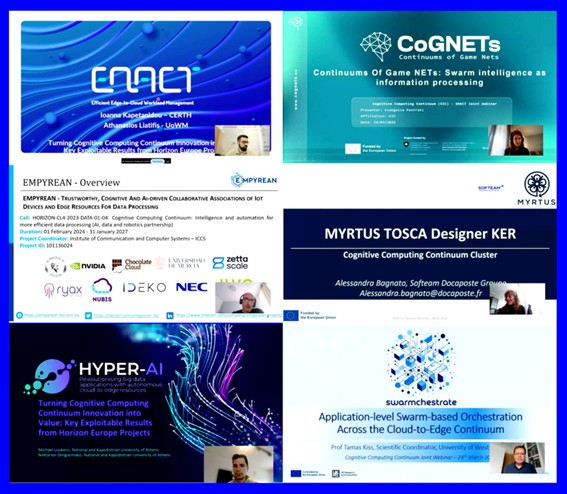
How do promising research results move beyond papers and prototypes into technologies that industry can adopt? That was the central question behind the joint webinar “Turning Cognitive Computing Continuum Innovation into Value: Key Exploitable Results from Horizon Europe Projects,” hosted by ENACT on 24 March 2026.
The online session brought together six Horizon Europe initiatives from Europe’s growing Cognitive Computing Continuum portfolio, consisting of the projects CoGNETs, EMPYREAN, ENACT, HYPER AI, MYRTUS, and SWARMCHESTRATE, to present some of their most mature and market-relevant outcomes. Rather than focusing purely on technical depth, the webinar emphasised exploitation pathways, real-world relevance, and long-term impact across Europe’s digital ecosystem.
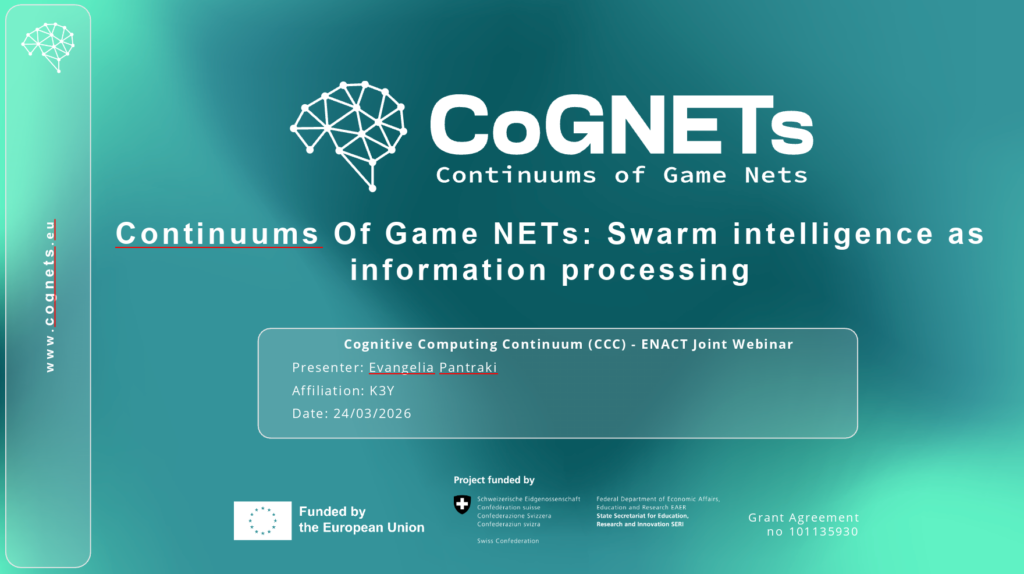
For CoGNETs, Evangelia Pantraki (K3Y) presented the project’s vision of swarm intelligence as information processing, showcasing how decentralised AI coordination could become a practical foundation for future IoT-Edge-Cloud infrastructures. Presenting for and representing the sister projects were Panagiotis Kokkinos (EMPYREAN), Ioanna Kapetanidou and Athanasios Liatifis (ENACT), Michael Loukeris (HYPER AI), Alessandra Bagnato (MYRTUS), and Tamas Kiss (SWARMCHESTRATE).
A Middleware for the AI Continuum
At the centre of the CoGNETs presentation was its open distributed middleware framework for autonomous orchestration across the IoT–Edge–Cloud continuum. As AI workloads become increasingly distributed and dynamic, conventional centralised orchestration models face growing limits in scalability, resilience, energy efficiency, and security. CoGNETs addresses this challenge through a decentralised, secure, and energy-aware coordination layer designed for next-generation AI services.
The framework combines three core innovation pillars:
- Game Intelligent Agent System for decentralised decision-making, pricing, bidding, and adaptive swarm coordination
- Decentralised Multi-Context Broker for workload placement, lifecycle management, and synchronisation across distributed nodes
- End-to-End Security, Identity & Resilience Mechanisms including decentralised identity, hardware attestation, and AI-level protection
Together, these components aim to create infrastructures where AI services can self-organise, scale efficiently, and remain trustworthy across multiple environments.
From Theory to Real Use Cases
The webinar also highlighted how CoGNETs is applying its architecture in concrete pilots across three strategic sectors.
In manufacturing, the platform supports adaptive AI execution in robotic production lines, where compute-intensive visual inspection tasks can be dynamically offloaded to edge or cloud resources. In mobility, CoGNETs enables distributed AI for electric vehicle powertrain optimisation under fluctuating connectivity and energy constraints. In healthcare, the middleware supports secure processing of sensitive medical data across hospital edge and cloud systems with identity-based access controls.
These pilots reflect a broader trend in European digital innovation: AI systems are no longer confined to a single data centre or device. They are becoming distributed ecosystems that must continuously balance performance, privacy, trust, and energy efficiency.
Building Europe’s Open Innovation Ecosystem
Beyond technology, CoGNETs underlined its open-source exploitation strategy, with core middleware components planned under permissive licences and alignment with European ecosystems such as FIWARE and ETSI NGSI-LD. The project positions this as a route toward stronger European digital sovereignty, SME participation, and leadership in distributed AI and Cloud-Edge-IoT systems.
As Europe invests in the next generation of AI infrastructures, initiatives like CoGNETs show that the future may depend not only on smarter models, but on smarter ways for systems to work together.
Find out more about the CoGNETs presentation: