

What happens when distributed AI moves beyond architecture diagrams and into hospitals, factories and other demanding real-world environments? At the European Big Data Value Forum 2026 in Galway, CoGNETs brought its research to one of Europe’s key meeting points for the data and AI community, with live demonstrations, a cross-project session on trustworthy AI infrastructure and new connections across the European research landscape.
From 30 September to 1 October, the European Big Data Value Forum (EBDVF) 2026 brought researchers, technology providers, industry representatives, policymakers and European initiatives together in Galway to discuss the technologies and conditions shaping Europe’s data and AI future.
For CoGNETs, this was an especially relevant community. The project is exploring how distributed intelligence and adaptive services can operate across the IoT-Edge-Cloud continuum, connecting computing resources, data and AI across environments rather than assuming that intelligence resides in a single location. Questions around federated learning, resource allocation, data governance, security, trust and real-world adoption therefore intersect closely with the wider conversations taking place at EBDVF.
Over two days, CoGNETs brought these ideas to the forum through live demonstrations from its Manufacturing and Health Pilot Use Cases (PUCs), alongside a dedicated session examining what trustworthy AI infrastructure means once AI enters real operational environments.
Distributed AI in action at the CoGNETs booth
At the CoGNETs booth on the second floor of Dexcom Stadium, visitors could see how some of these concepts translate into concrete applications in healthcare and manufacturing.
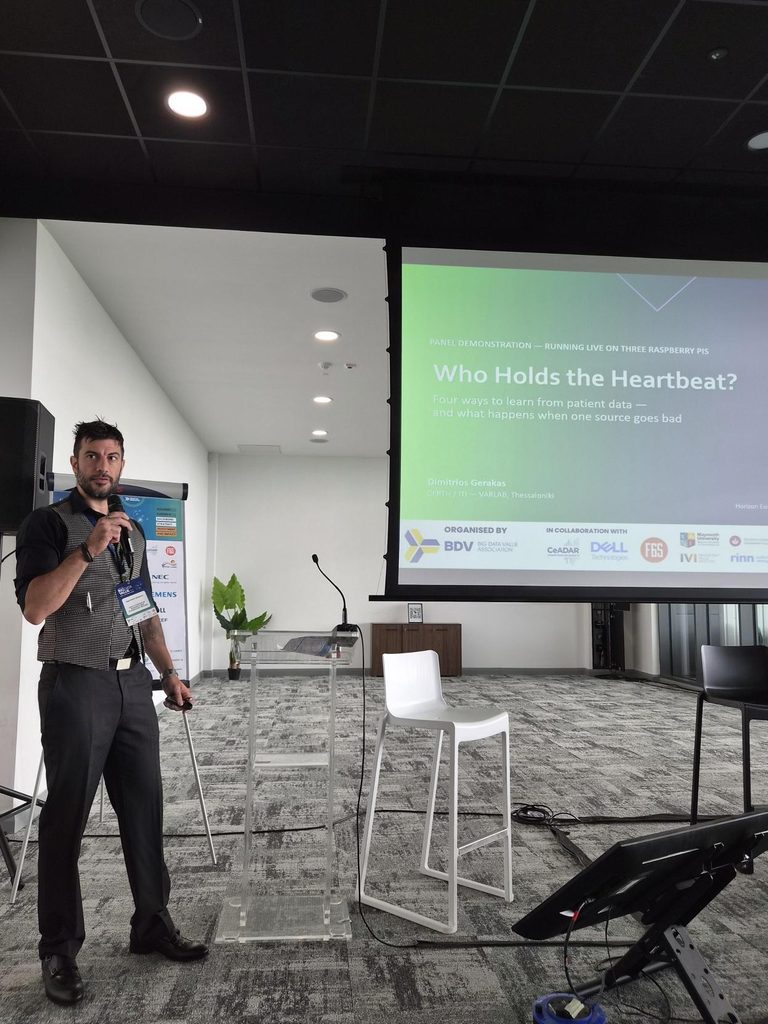
Dimitris Gerakas from CERTH presented “4 Ways to Trust a Heartbeat”, a demonstration connected to the CoGNETs Health PUC. Three Raspberry Pi computers represented three healthcare institutions, each holding local recordings of a patient’s movement and heart rate. All faced the same machine-learning task: predicting heart rate from movement. What differed was how they learned.
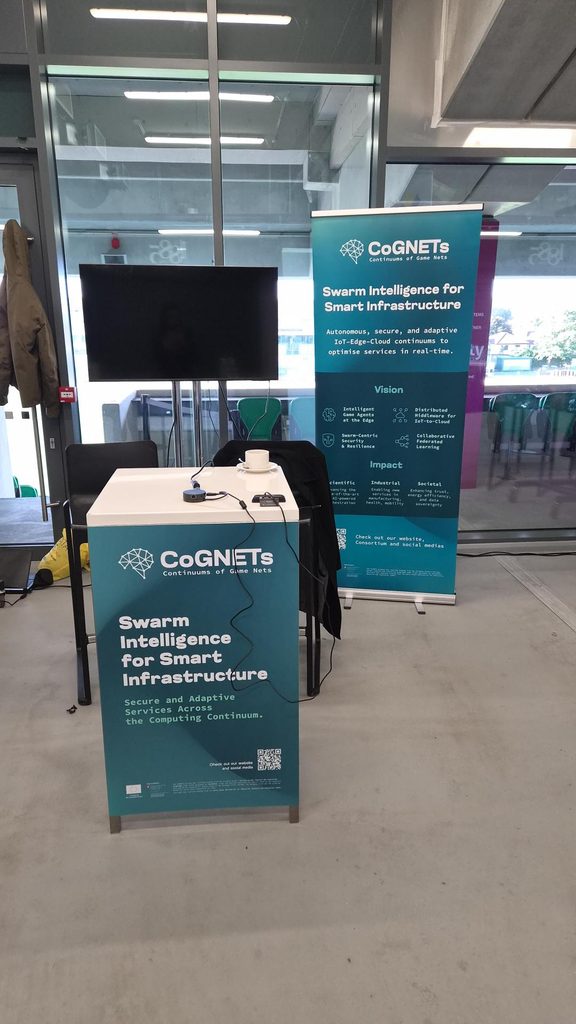
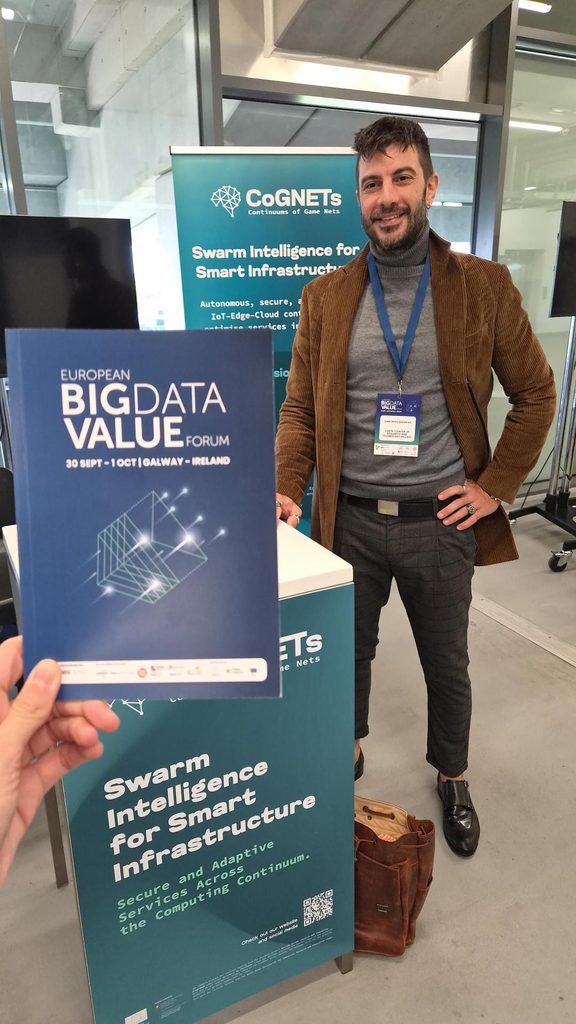
The demonstration compared four approaches: learning independently at each institution, bringing the data together for centralised training, keeping the data local while sharing learned information through a coordinator using federated learning, and allowing participants to learn directly from one another without a central coordinator.
A second part of the experiment deliberately corrupted one participant’s data, representing a faulty or compromised source. Visitors could then observe whether the problem remained local or affected models elsewhere in the network, and how different approaches could identify and respond to unreliable contributions. The experiment also highlighted a particularly important healthcare challenge: unusual data are not necessarily bad data. A contribution that looks anomalous may simply represent a patient who differs from the wider population.
Just a few steps away, Axel Vick from Fraunhofer IPK brought the same distributed-intelligence principle into manufacturing. His demonstration represented three different manufacturing locations working with different sets of industrial parts. Locally trained object-detection models could recognise the objects they had encountered, but struggled with unfamiliar objects from another location.
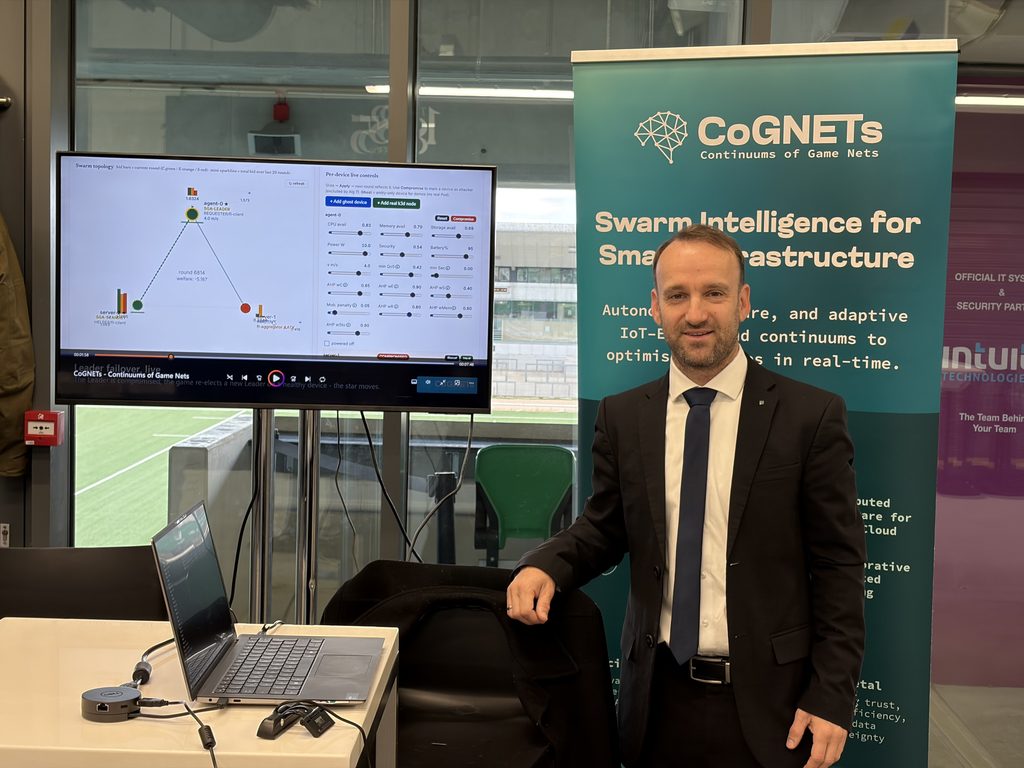
Federated learning offered another approach. Knowledge learned at different locations could contribute to broader object-detection capabilities without requiring the original local datasets to be exchanged. The demonstration also connected distributed training with the wider CoGNETs approach to assigning computing resources, and showed how the resulting capabilities could support downstream industrial applications such as robotic handling, assembly and disassembly.
Together, the two demonstrations made an important part of the CoGNETs proposition visible. In environments where data, computing resources and physical systems are already distributed, AI does not necessarily need everything to be brought into one place before useful intelligence can emerge.
Trustworthy AI is more than a trustworthy model
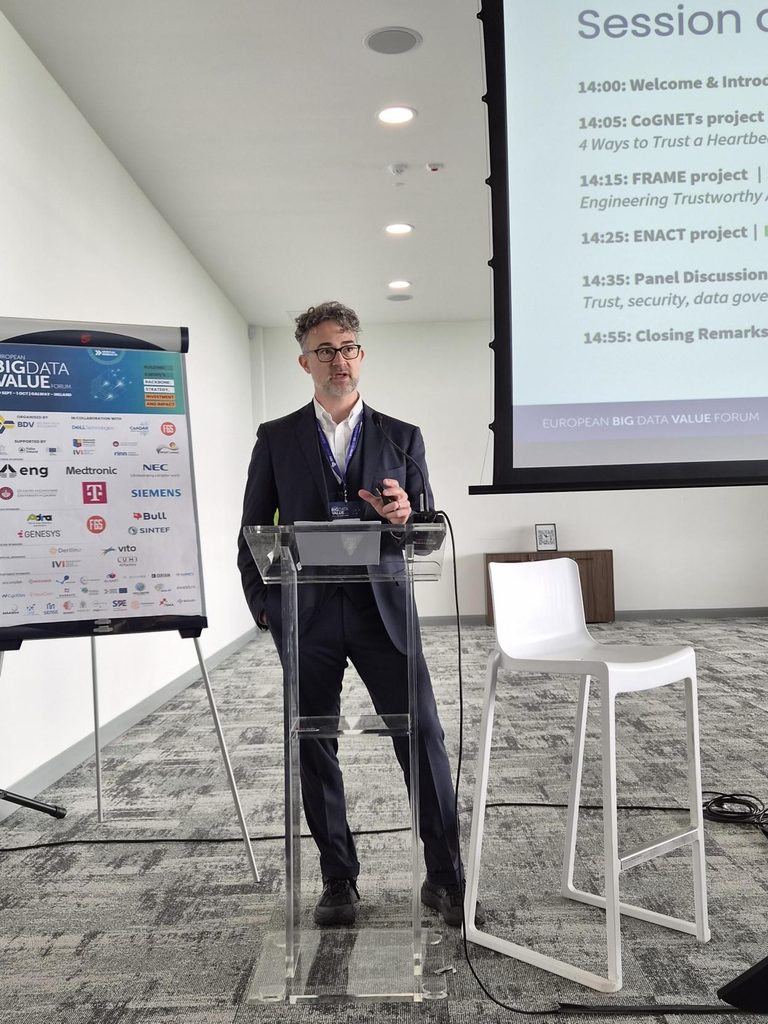
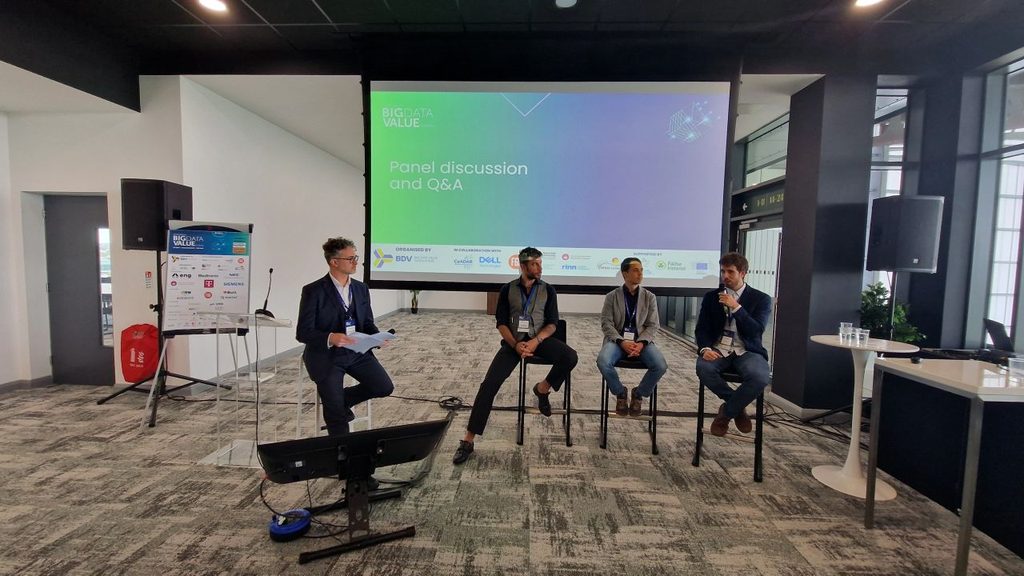
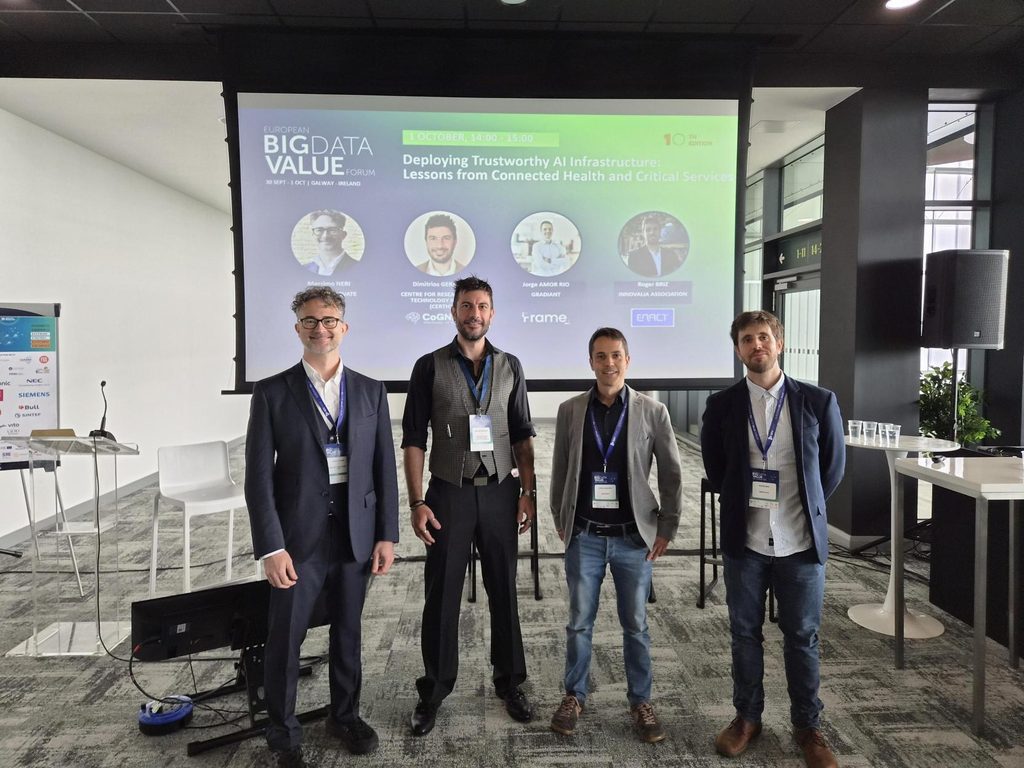
The questions raised at the booth fed directly into a broader discussion on 1 October, when CoGNETs organised “Deploying Trustworthy AI Infrastructure: Lessons from Connected Health and Critical Services.”
Moderated by Massimo Neri, Chief Technology Officer at Martel Innovate, the session brought together three Horizon Europe projects to examine trustworthiness from different operational perspectives.
For CoGNETs, Dimitris Gerakas used the healthcare use case to explore the implications of centralised, federated and decentralised learning, including what happens when one participant contributes unreliable information.
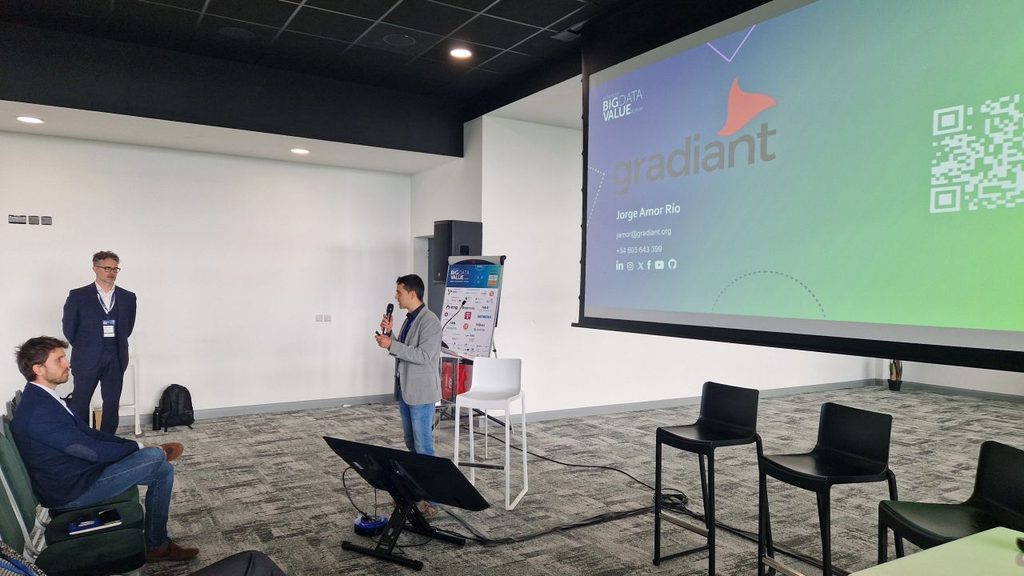
Jorge Amor Rio from Gradiant presented the perspective of FRAME, where AI agents are being explored for clinical decision support. His presentation focused particularly on observability and tracing, and on the evidence needed to understand how increasingly complex AI agents use data, models, tools and external services when arriving at an outcome.
Roger Briz from Innovalia Association brought the perspective of ENACT Horizon, using a live-event environment to demonstrate adaptive edge-cloud infrastructure. Here, changing demand, network conditions and available resources require infrastructure to continuously observe its environment, make decisions, adapt and assess whether those changes produced the intended result.
The applications were deliberately different, but the discussion revealed a common thread. Trustworthiness cannot be reduced to the properties of an AI model. It also depends on the wider system in which that model operates: how data are managed, how distributed components interact, how behaviour can be observed and reconstructed, what happens when conditions change, and where humans retain oversight over automated decisions.
The vertical perspective proved equally important. Healthcare introduces stringent requirements around sensitive data, institutional boundaries, reliability and human oversight. Critical and data-intensive services expose AI systems to dynamic operational conditions. Manufacturing adds requirements around industrial data, robotics and distributed production environments. These settings provide more than opportunities to demonstrate technology. They reveal requirements, trade-offs and adoption barriers that are difficult to understand through technical development alone.
Connecting CoGNETs with Europe’s trustworthy AI ecosystem
EBDVF also provided an opportunity to connect CoGNETs with related European initiatives working on other parts of the trustworthy AI and data landscape.
CoGNETs’ sister project CERTAIN was present in Galway through the DICE Alliance (Data, Innovation, Compliance, Ethics), which is bringing together European research on trustworthy data and AI operations, compliance, privacy and responsible data use.
While CoGNETs approaches trustworthiness largely through the infrastructure and services needed for distributed intelligence, CERTAIN addresses complementary questions around making trustworthy and compliant AI and data operations actionable in practice. Bringing these perspectives into the same forum helps connect technical advances in distributed AI with the wider European discussion around governance, compliance and responsible adoption.
Read more about CERTAIN and the DICE Alliance at EBDVF 2026
Such connections matter as Europe moves from defining principles for trustworthy AI towards implementing them. Data governance, regulatory requirements and infrastructure design increasingly meet at the point where AI systems are actually deployed. No single project addresses that entire landscape, making collaboration and exchange across European initiatives an important part of turning research results into technologies that can be adopted.
Why EBDVF matters for CoGNETs
For CoGNETs, being at EBDVF was therefore about more than disseminating project results.
The forum brings together many of the communities that will ultimately influence whether computing-continuum technologies move from research into wider use, including AI and data researchers, infrastructure providers, technology developers, industrial stakeholders, European initiatives and organisations working on data policy and governance.
This provides an opportunity to test not only whether the technology works, but whether it addresses problems that matter to potential users and adopters.
The conversations in Galway touched on questions that sit at the heart of the CoGNETs research agenda. Distributed organisations increasingly need to benefit from data and intelligence without necessarily centralising everything first. AI services need to make use of computing resources spread across devices, edge infrastructure and cloud environments. Collaborative systems need to remain dependable when data sources, network conditions or available resources change. At the same time, the technologies need to fit the operational and governance requirements of the sectors expected to use them.
Engaging with the EBDVF community helps place CoGNETs’ technical developments within that wider context and provides feedback on where distributed intelligence can create practical value.
Next stop: inside the CoGNETs Pilot Use Cases
The demonstrations in Galway provided only a glimpse of the work taking place across the project’s three Pilot Use Cases.
Over the coming weeks, the CoGNETs website will publish a dedicated series of articles on the Manufacturing, Mobility and Health PUCs. Each will take a closer look at the challenges facing its respective vertical, the technologies being developed and tested within CoGNETs, the organisations involved, and the potential value for future users and adopters.
The healthcare demonstration in Galway showed three small computers learning from distributed patient data. The manufacturing demonstration showed how knowledge could travel between virtual factory environments without the underlying datasets following it. Behind both experiments lies a much larger technological shift.
As AI becomes embedded in connected physical and digital environments, intelligence will increasingly need to operate across organisational, geographical and computational boundaries. EBDVF 2026 gave CoGNETs the opportunity to demonstrate what that shift can look like, and to discuss with Europe’s data and AI community what it will take to make it work in practice.