

A joint Horizon Europe discussion at Data Week 2026
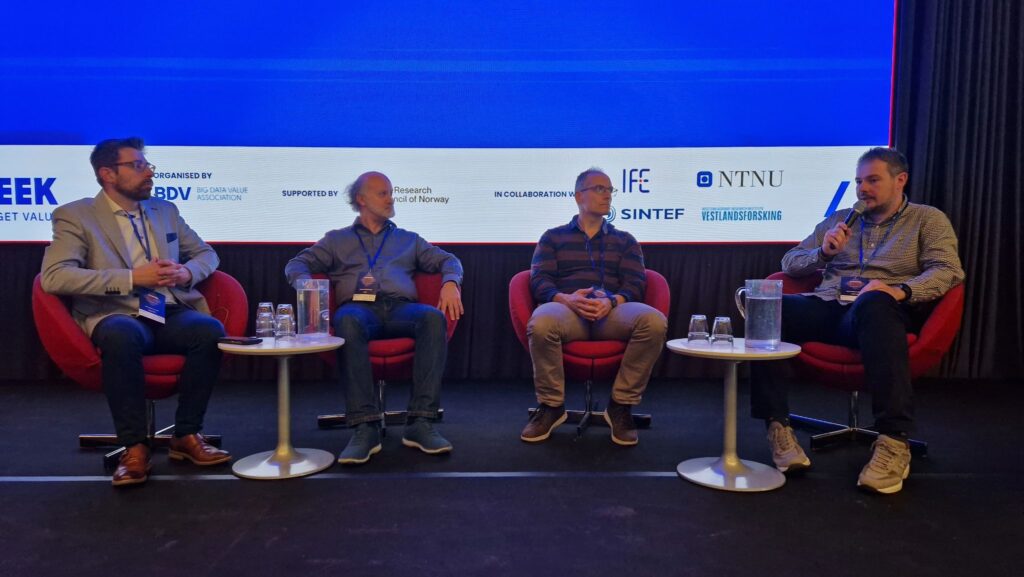
The promise of Europe’s cognitive computing continuum is ambitious: AI systems capable of operating seamlessly across edge devices, cloud platforms, and high-performance computing infrastructures while remaining trustworthy, interoperable, and energy efficient.
This vision was further explored during the workshop “From Data to Decisions: AI Lifecycle Management Across the Cognitive Computing Continuum”, held at Data Week 2026 in Oslo, Norway, on 5-6 May 2026. The session was co-organised by CoGNETs together with fellow Horizon Europe projects EMPYREAN, ENACT, INTEND, and Swarmchestrate as part of the EUCloudEdgeIoT.eu cognitive computing continuum cluster.
Organised by the BDVA – Big Data Value Association in collaboration with IFE, NTNU, SINTEF, and the Western Norway Research Institute, Data Week 2026 brought together Europe’s data and AI research and innovation community under the theme “Data Fjords: Unlocking AI for Industry and Society.” The event focused on how Europe can accelerate the transformation of AI research into operational value for industry, public services, and society.
Within this broader context, the workshop examined one of the emerging challenges facing Europe’s AI ecosystem: how to manage the full AI lifecycle across distributed, heterogeneous infrastructures while ensuring trust, scalability, interoperability, and compliance. Representing CoGNETs in the joint cluster session, Georgios Spanos from the Centre for Research & Technology Hellas joined speakers from the participating projects to discuss how distributed AI systems can evolve from fragmented experimentation toward operational deployment across the computing continuum.
Complementary technologies for the cognitive computing continuum
Throughout the session, the participating projects revealed how Europe’s cognitive computing continuum is beginning to evolve from a collection of isolated research directions into a layered operational ecosystem for distributed AI.
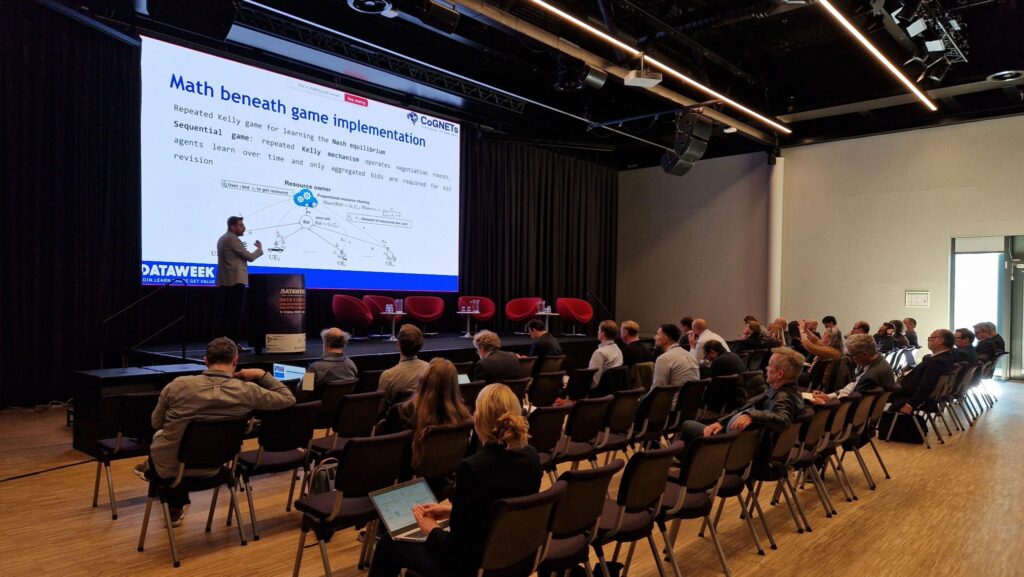
Representing CoGNETs, Georgios Spanos (CERTH) explored how swarm intelligence, collaborative AI, and decentralised coordination mechanisms can support autonomous self-organisation across distributed systems. Rather than relying exclusively on centralised orchestration, the CoGNETs approach investigates how intelligence can emerge dynamically through interactions between distributed nodes, agents, and services. This reflects a broader transition currently taking place in the field: from static orchestration models toward adaptive, self-organising infrastructures capable of responding in real time to changing network, compute, and contextual conditions.
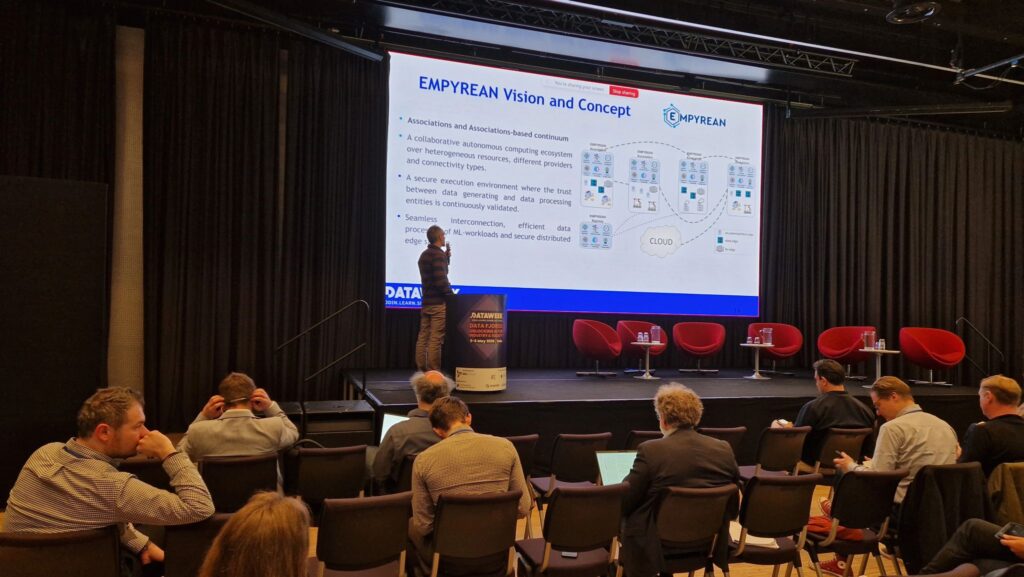
Alongside him, Panagiotis Kokkinos (ICCS/NTUA), representing EMPYREAN, presented adaptive orchestration frameworks, SDKs, and distributed MLOps toolchains designed to operationalise AI services across heterogeneous edge-to-cloud environments. His presentation focused on one of the central engineering challenges of the computing continuum: how to dynamically schedule and optimise AI workloads across infrastructures with radically different latency, compute, and energy characteristics while maintaining observability and operational efficiency.
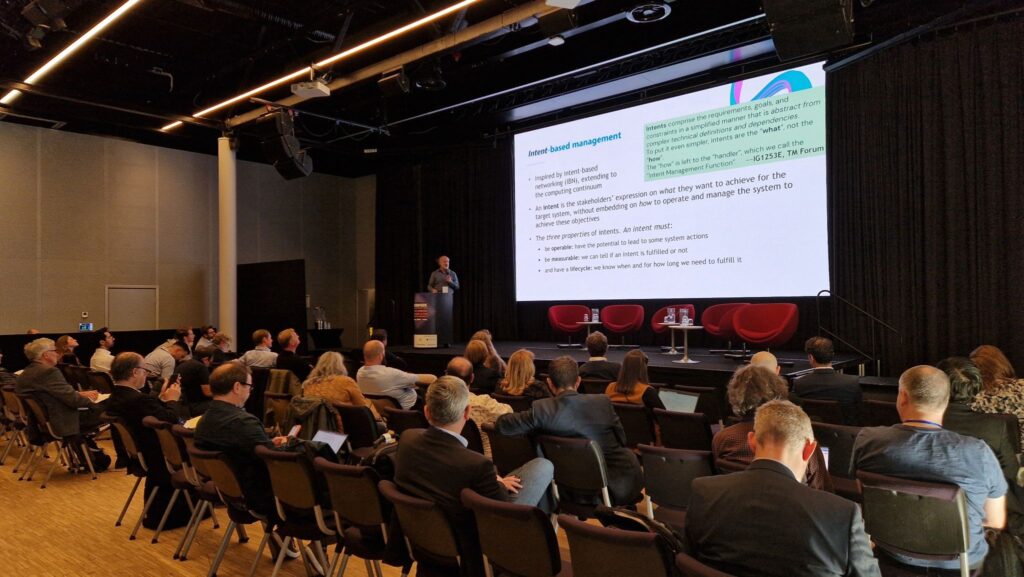
Valerio Frascolla (Intel), representing INTEND, focused on adaptive scheduling, observability, and energy-aware optimisation mechanisms for distributed AI services. His presentation highlighted the growing importance of balancing AI performance with sustainability constraints, particularly as Europe moves toward large-scale deployment of AI workloads across highly distributed infrastructures spanning edge, cloud, and HPC resources. Representing ENACT, Alexandros Nizamis (CERTH), introduced approaches centred around intent-driven orchestration and intelligent data management. As AI pipelines become increasingly distributed and complex, ENACT explores how high-level operational objectives can be translated automatically into infrastructure behaviour, reducing management complexity while improving scalability and interoperability across the continuum.
Tamas Kiss (University of Westminster), representing Swarmchestrate, explored decentralised orchestration models inspired by collaborative swarm behaviour. The project investigates how distributed infrastructures can coordinate autonomously at runtime without depending entirely on central control layers, an increasingly relevant capability for dynamic and large-scale environments where responsiveness, resilience, and scalability become critical operational requirements.
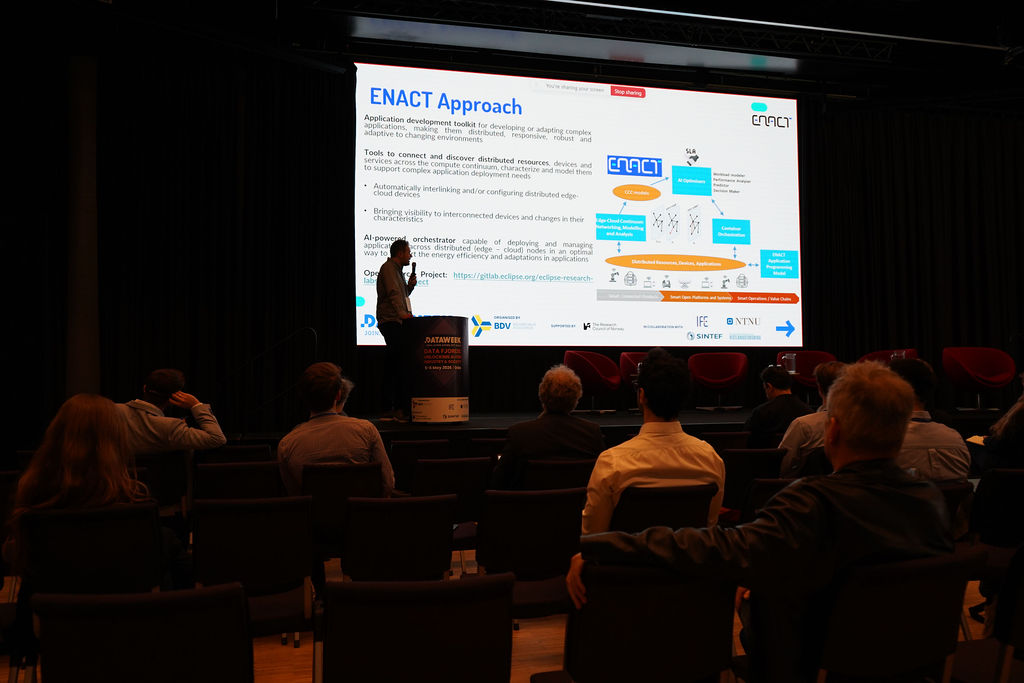
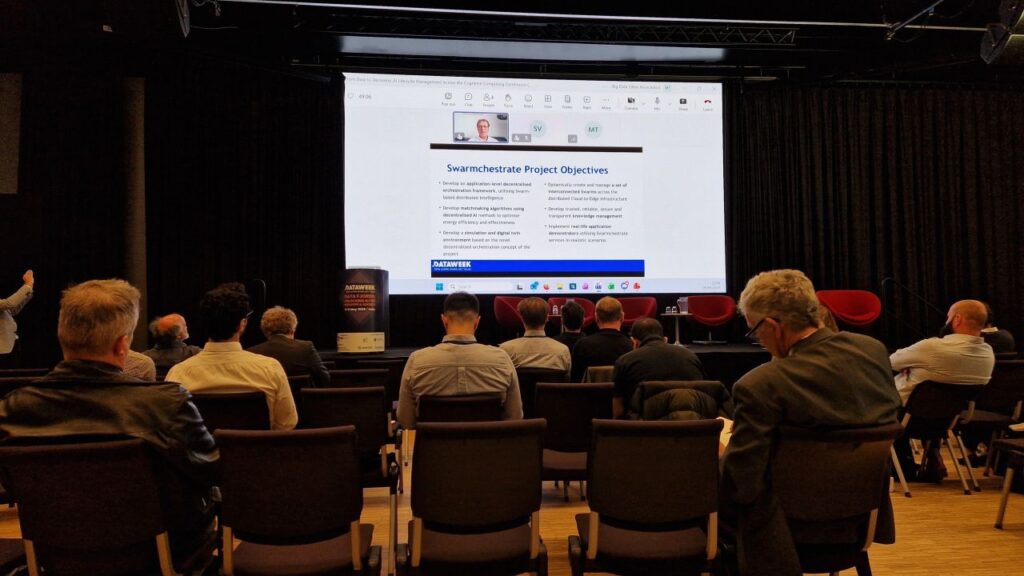
What made the session particularly compelling was not simply the diversity of technologies presented, but the way each project addressed a different bottleneck in the AI lifecycle. Some initiatives concentrated on orchestration, operational optimisation, and lifecycle automation, tackling the challenge of dynamically managing AI workflows across infrastructures where resources and conditions continuously evolve. Others focused on decentralised intelligence, collaborative learning, cybersecurity, and autonomous coordination mechanisms capable of enabling systems to self-organise and adapt at runtime.
Taken together, the presentations highlighted an important shift currently taking place across Europe’s AI ecosystem. The focus is moving beyond isolated AI models toward the engineering of full-stack operational environments capable of supporting observability, interoperability, trustworthiness, resilience, and continuous optimisation across the computing continuum.
At the same time, the discussions revealed a growing convergence around shared technological foundations. Kubernetes-native orchestration, containerised workloads, distributed MLOps practices, federated infrastructures, and interoperable runtime environments repeatedly emerged as common building blocks across projects. These technologies are increasingly forming the operational backbone required to support scalable AI deployment across heterogeneous European infrastructures. What differed was not the underlying technological direction, but the architectural philosophy layered on top of it, from intent-driven automation and adaptive scheduling to swarm-based coordination, collaborative intelligence, and privacy-preserving resource negotiation.
For researchers and practitioners working in distributed AI and continuum computing, this convergence may be one of the clearest indications yet that Europe’s cognitive computing ecosystem is beginning to mature into a more coherent operational paradigm: one capable of supporting trustworthy, adaptive, and scalable AI systems for industry and society.
Governance, trust, and the European AI strategy
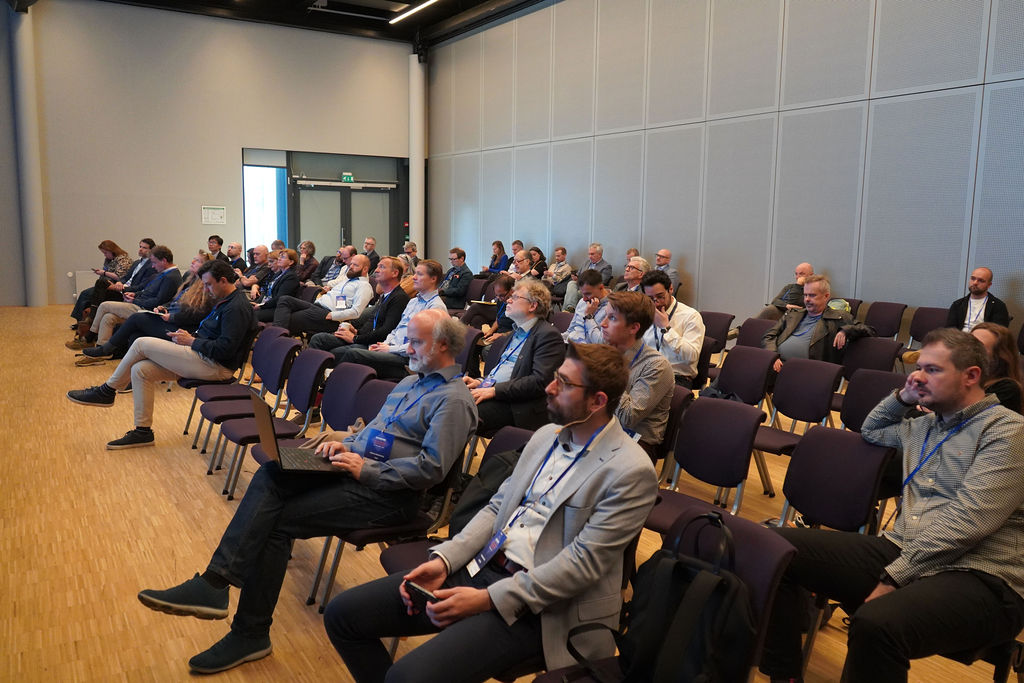
The workshop also highlighted the growing importance of governance and trust in distributed AI systems. As AI pipelines become more decentralised, questions surrounding interoperability, compliance, data sovereignty, cyber-resilience, and transparency become increasingly critical. In this context, Europe’s evolving regulatory and governance frameworks, including the AI Act and Data Governance Act, are helping shape how future AI infrastructures are designed and operated. Several discussions therefore focused not only on technical scalability, but also on how collaborative AI systems can remain secure, observable, privacy-preserving, and energy efficient as they move toward operational deployment.
Cross-project dialogue played a central role throughout the session. Questions exchanged between speakers addressed challenges such as scaling AI workloads while controlling energy consumption, transitioning AI lifecycle automation from pilots into production environments, simplifying orchestration through intent-driven systems without sacrificing transparency, and identifying where decentralised swarm architectures can outperform centralised coordination models.
More broadly, the workshop reflected a wider shift currently taking place across Europe’s AI landscape. The discussion is gradually moving beyond isolated experimentation toward integrated ecosystems capable of supporting trustworthy AI deployment across industry and society.This session reinforced how collaborative Horizon Europe initiatives are contributing to that broader ecosystem, not only by advancing individual technologies, but by helping define how distributed AI infrastructures can operate coherently across the cognitive computing continuum.